Conventions
States and Bases
Bases
A basis refers to a set of two eigenstates. The transition between these two states is said to be addressed by a channel that targets that basis. Namely:
Basis |
Eigenstates |
|
|---|---|---|
|
\(|g\rangle,~|r\rangle\) |
|
|
\(|g\rangle,~|h\rangle\) |
|
|
\(|0\rangle,~|1\rangle\) |
|
Qutrit state
The qutrit state combines the basis states of the ground-rydberg and digital bases,
which share the same ground state, \(|g\rangle\). This qutrit state comes into play
in the digital approach, where the qubit state is encoded in \(|g\rangle\) and
\(|h\rangle\) but then the Rydberg state \(|r\rangle\) is accessed in multi-qubit
gates.
The qutrit state’s basis vectors are defined as:
Qubit states
Caution
There is no implicit relationship between a state’s vector representation and its associated measurement value. To see the measurement value of a state for each measurement basis, see Initial State and Measurement Conventions .
When using only the ground-rydberg or digital basis, the qutrit state is not
needed and is thus reduced to a qubit state. This reduction is made simply by tracing-out
the extra basis state, so we obtain
ground-rydberg: \(|r\rangle = (1, 0)^T,~~|g\rangle = (0, 1)^T\)digital: \(|g\rangle = (1, 0)^T,~~|h\rangle = (0, 1)^T\)
On the other hand, the XY basis uses an independent set of qubit states that are
labelled \(|0\rangle\) and \(|1\rangle\) and follow the standard convention:
XY: \(|0\rangle = (1, 0)^T,~~|1\rangle = (0, 1)^T\)
Multi-partite states
The combined quantum state of multiple atoms respects their order in the Register.
For a register with ordered atoms (q0, q1, q2, ..., qn), the full quantum state will be
Note
The atoms may be labelled arbitrarily without any inherent order, it’s only the
order with which they are stored in the Register (as returned by
Register.qubit_ids) that matters .
State Preparation and Measurement
Basis |
Initial state |
Measurement |
|---|---|---|
|
\(|g\rangle\) |
\(|r\rangle \rightarrow 1\)
\(|g\rangle,|h\rangle \rightarrow 0\)
|
|
\(|g\rangle\) |
\(|h\rangle \rightarrow 1\)
\(|g\rangle,|r\rangle \rightarrow 0\)
|
|
\(|0\rangle\) |
\(|1\rangle \rightarrow 1\)
\(|0\rangle \rightarrow 0\)
|
Measurement samples order
Measurement samples are returned as a sequence of 0s and 1s, in
the same order as the atoms in the Register and in the multi-partite state.
For example, a four-qutrit state \(|q_0, q_1, q_2, q_3\rangle\) that’s projected onto \(|g, r, h, r\rangle\) when measured will record a count to sample
0101, if measured in theground-rydbergbasis0010, if measured in thedigitalbasis
Hamiltonians
Tip
This section uses formulas that rely on the Indexed Operator notation.
Independently of the mode of operation, the Hamiltonian describing the system can be written as
where \(H^D_i\) is the driving Hamiltonian for atom \(i\) and \(H^\text{int}_{ij}\) is the interaction Hamiltonian between atoms \(i\) and \(j\). Note that, if multiple basis are addressed, there will be a corresponding driving Hamiltonian for each transition.
Driving Hamiltonian
The driving Hamiltonian describes the coherent excitation of an individual atom between two energies levels, \(|a\rangle\) and \(|b\rangle\), with Rabi frequency \(\Omega(t)\), detuning \(\delta(t)\) and phase \(\phi(t)\).
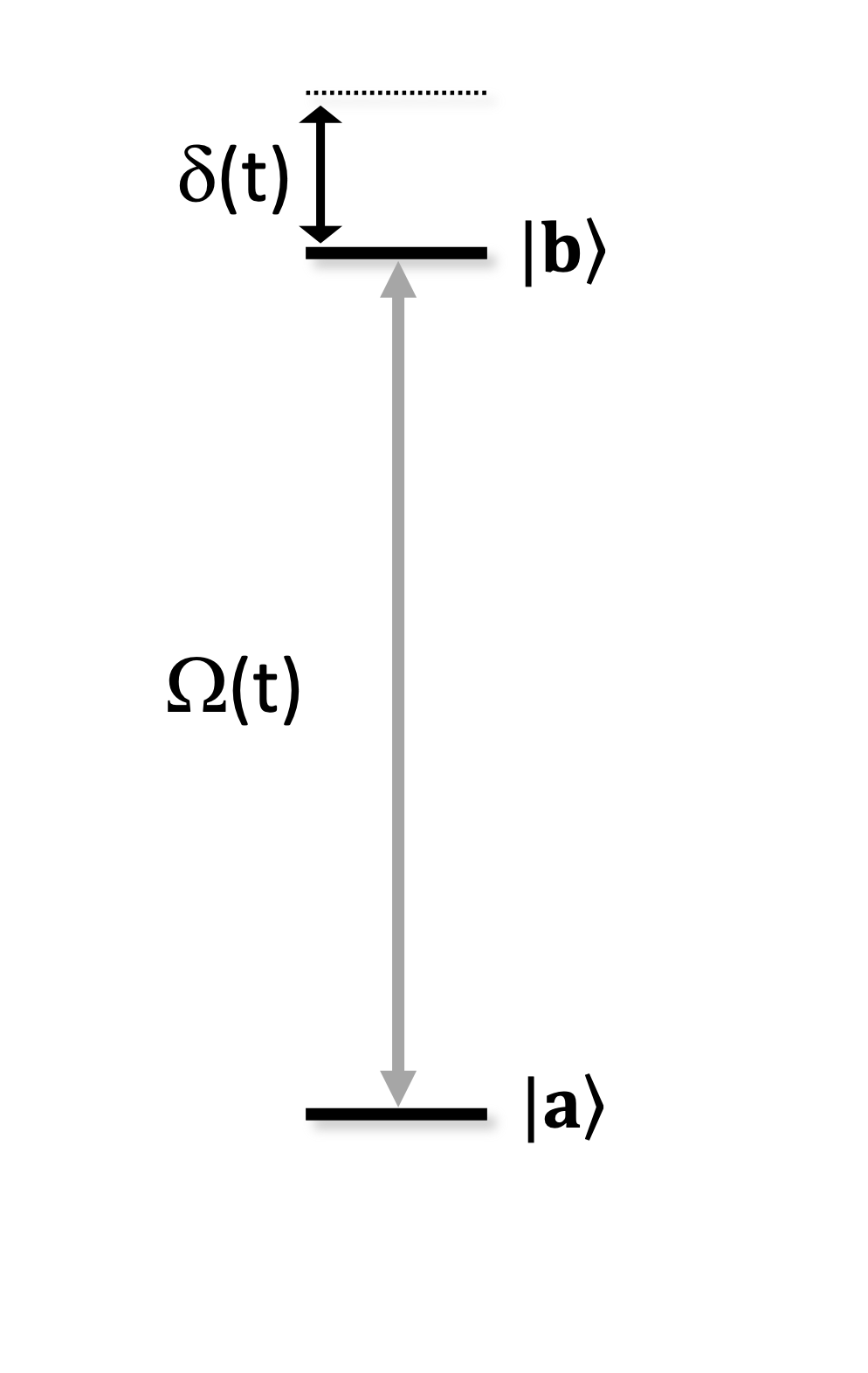
The coherent excitation is driven between a lower energy level, \(|a\rangle\), and a higher energy level, \(|b\rangle\), with Rabi frequency \(\Omega(t)\) and detuning \(\delta(t)\).
Warning
In this form, the Hamiltonian is independent of the state vector representation of each basis state, but it still assumes that \(|b\rangle\) has a higher energy than \(|a\rangle\).
Pauli matrix form
A more conventional representation of the driving Hamiltonian uses Pauli operators instead of projectors. However, this form now depends on the state vector definition of \(|a\rangle\) and \(|b\rangle\).
Case 1. Descending energy order
Important
In pulser-simulation, this is the case for the ground-rydberg basis, since
When the basis vectors are defined in descending energy order, we have
Thus, the Pauli and excited state occupation operators are defined as
and the driving Hamiltonian takes the form
Case 2. Ascending energy order
Important
In pulser-simulation, this is the case for the XY basis, since
When the basis vectors are defined in ascending energy order, we have
This changes the operators and Hamiltonian definitions with respect to Case 1, as rewriten below with highlighted differences.
Note
This is also the Hamiltonian one should use when trying to reconcile the basis states of the ground-rydberg basis
with the computational-basis state-vector convention, i.e.
Interaction Hamiltonian
The interaction Hamiltonian depends on the states involved in the sequence.
When working with the ground-rydberg and digital bases, atoms interact
when they are in the Rydberg state \(|r\rangle\):
where \(\hat{n}_i = |r\rangle\langle r|_i\) (the projector of atom \(i\) onto the Rydberg state), \(R_{ij}^6\) is the distance between atoms \(i\) and \(j\) and \(C_6\) is a coefficient depending on the specific Rydberg level of \(|r\rangle\).
On the other hand, with the two Rydberg states of the XY
basis, the interaction Hamiltonian takes the form
where \(C_3\) is a coefficient that depends on the chosen Ryberg states.
Note
The definitions given for both interaction Hamiltonians are independent of the chosen state vector convention.
Notation
Indexed Operator
Whenever an arbitrary operator is written with an index (typically \(i\) or \(j\)), e.g. \(\hat{O}_i\), it is implicit that \(\hat{O}\) is applied only to qudit \(i\) while the rest of the qudits are applied the identity operator, \(\hat{I}\). Put another way,
where \(1 \leq i \leq N\).
This notation is extendable to multiple indices. Take for instance the case with two indices, \(\hat{O}_{ij}\) – here, \(\hat{O}\) is a two-qudit operator. A good example is the interaction Hamiltonian in the ground-rydberg basis, which we write as
where \(1 \leq j < i \leq N\).
Note that, generally, we cannot write \(\hat{O}_{ij}\) in the form used above because \(\hat{O}\) might not be separable in a tensor product of two single-qudit operators, but the operator is valid nonetheless.